In September 2026, ISO 9001:2026 is published, the new edition of the world's most widely used quality management standard. It replaces ISO 9001:2015, which has been the foundation for quality management systems for more than ten years. Publication also starts the transition period: certificates issued against the 2015 edition are expected to lose their validity in September 2029. For every organisation holding an ISO 9001 certificate, this is therefore the moment to determine what the revision means in practice. The good news first: the foundations remain in place. The emphasis shifts.
What stays the same
The key message of the new edition is that there is no structural break. Certification bodies describe the revision as evolutionary, not revolutionary. Specifically, the following remains intact:
If you have a well-functioning quality management system today, you do not need to start over. The revision asks for greater depth on a number of themes, not for a new system.
What changes in ISO 9001:2026
Based on the FDIS text and the guidance published by certification bodies, we see six points of emphasis that will affect most organisations.
1. Top management, quality culture and ethical conduct
The standard makes the role of top management more explicit. Leadership means more than setting policy and providing resources: it also means actively promoting a quality culture and demonstrating ethical conduct. Auditors will therefore ask more often how top management makes this visible, for example in the management review and in communication with employees.
2. A stronger link between context, strategy and decision-making
The context analysis becomes less of a mandatory document and more of a steering instrument. The new edition draws a clearer connection between the internal and external context, the organisation's strategic direction and the decisions that follow from it. The needs and expectations of interested parties also take a more prominent place in that analysis.
3. Climate change and sustainability
Through Amendment 1:2024, climate change was already a context factor to be assessed under the 2015 edition. In ISO 9001:2026 it is fully integrated into the text, together with broader attention to sustainability. You do not need to set up an environmental management system, but you do need to determine, with justification, whether climate and sustainability are relevant to your quality objectives.
4. Digitalisation, new technology and emerging risks
The standard calls for attention to the impact of digitalisation and new technology on processes, products and services. It does not contain detailed requirements for AI, for instance; ISO/IEC 42001 exists for that purpose. What ISO 9001:2026 does expect is that you include emerging risks in your risk assessment and in the planning of changes.
5. Clearer terminology and more explanation
Terms such as risks and opportunities and documented information have been clarified. Risks and opportunities are more clearly distinguished from each other, with greater emphasis on actively pursuing opportunities. This makes the standard easier to read and reduces the scope for differing interpretations between the organisation and the auditor.
6. An extensive informative annex
For the first time, ISO 9001 includes an extensive informative annex with guidance on implementation. The annex explains the structure, the terminology and the intent of the requirements. For quality managers this is a welcome addition: less dependence on external interpretations, more guidance from the standard itself.
What the transition looks like
Under the usual IAF transition rules, a three-year transition period applies from the date of publication. Certificates issued against ISO 9001:2015 are therefore expected to lose their validity in September 2029. In practice, the transition audit is usually combined with a regular surveillance or recertification audit, so you do not need to schedule an additional audit day. Three years sounds generous, but if you want the transition to coincide with a planned audit, you effectively have one or two audit moments to choose from.
What you can do now:
How uComply helps
Many organisations using uComply started with ISO 27001. Because ISO 9001:2026 follows the same Harmonized Structure, the quality standard is a logical second standard in the same environment. You manage the context analysis, the interested-party analysis and the management review once and use them for both standards. That is exactly what the new edition asks for: one coherent picture of context, strategy and decision-making.
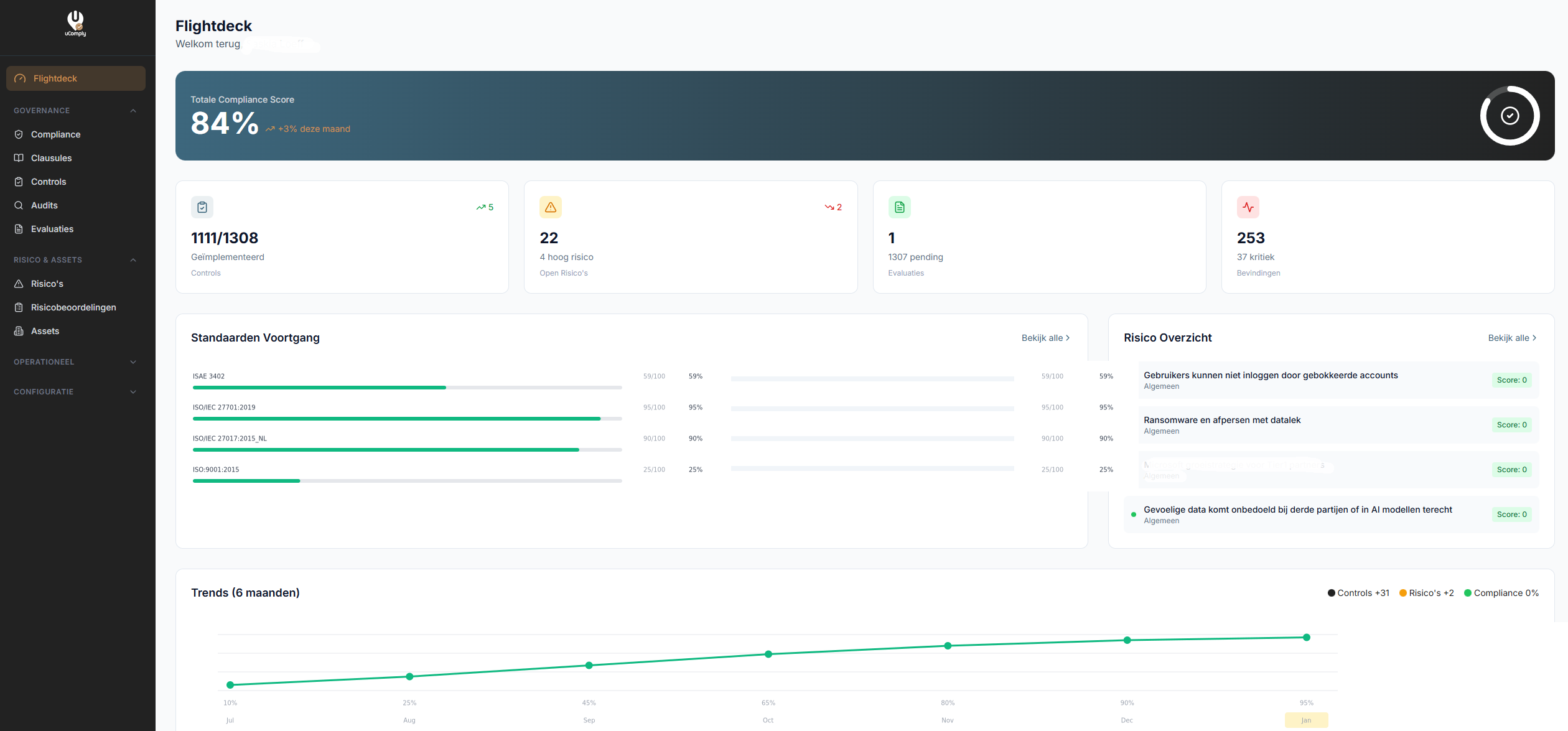
In uComply, controls exist once and are linked to multiple standard requirements. When you activate ISO 9001 alongside ISO 27001, the gap analysis immediately shows which requirements are already covered and where additions are needed. This avoids duplicate documentation and duplicate audits. Improvement actions from your transition plan are given an owner and a deadline, and you track progress per standard in the Flightdeck dashboard. The management review and the supporting evidence are ready the moment the auditor asks for them.
Summary
ISO 9001:2026 is not a new standard but a deepening of the familiar structure. Top management gets a more explicit role, context is more strongly connected to strategy, and climate, sustainability and digitalisation now form part of the analysis. With a three-year transition period there is time, but the number of suitable audit moments is limited. Start with a gap analysis and agree with your certification body when you will make the switch.
Would you like to see how to manage ISO 9001 and ISO 27001 in one management system, without duplicate work? Book a no-obligation demo or view our pricing and licence models.