##### 20 Aug 2025
Operational technology (OT) covers every system that controls a physical process, from a bridge control room to a production line. Those systems were deliberately kept apart from office networks for decades, but that separation is disappearing. Since 15 August 2026, many organisations that rely on OT also fall under the Dutch Cybersecurity Act. What does that mean in practice, and where do you start?
What is OT and where do you find it?
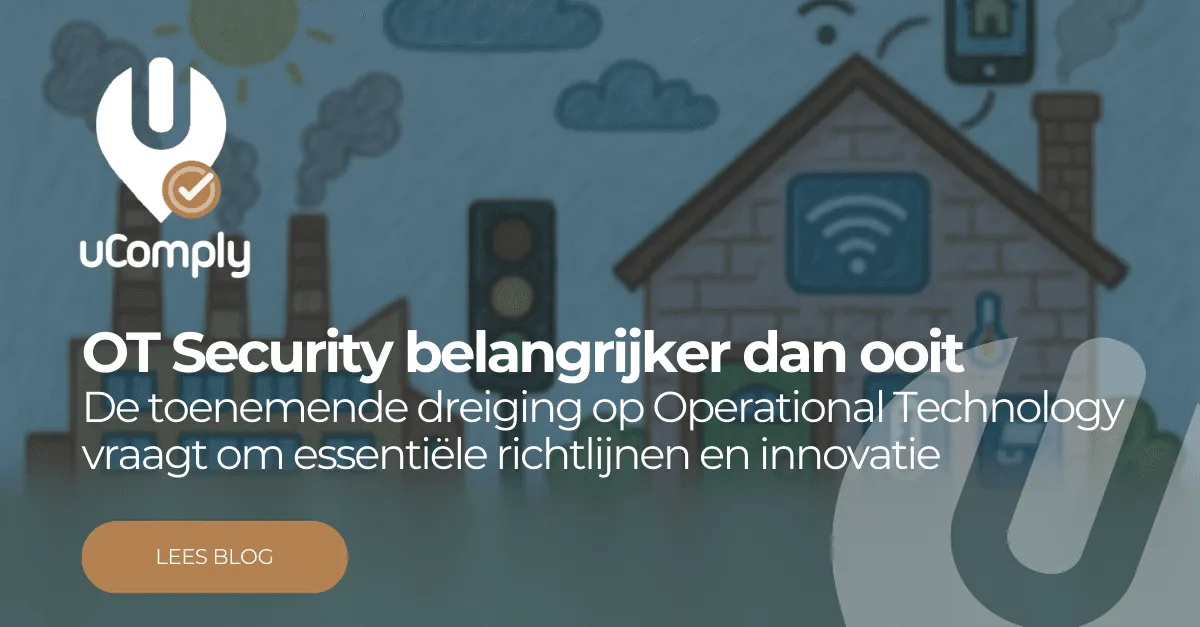
OT stands for operational technology: all the systems and devices that drive physical processes. At home that is the washing machine running at a set time or the robot vacuum doing its fixed rounds. In business it means machines on the factory floor, water treatment plants, traffic lights and bridge controls, and loading and unloading in ports and warehouses.
Precisely because OT runs in so many places — often at organisations delivering services in vital infrastructure — securing it is no longer optional. Two frameworks give direction: the IEC 62443 series for industrial automation and the Dutch Cybersecurity Act, the national implementation of NIS2.
Why securing OT differs from securing IT
Applying the IT playbook to OT will stall. The Dutch National Cyber Security Centre (NCSC) points out the differences that shape the approach:
The NCSC's five basic principles
In *Getting started with securing OT/IACS* the NCSC describes five basic principles. They make a workable sequence for organisations that are still at the beginning:
What the Dutch Cybersecurity Act means for OT
The Dutch Cybersecurity Act has been in force since 15 August 2026 and translates the NIS2 directive into national law. For organisations with OT in their primary process, four obligations stand out:
Whether you fall under the act, and who supervises you, depends on your sector. The Dutch Authority for Digital Infrastructure maintains an overview of the supervised sectors and the NCSC collects the practical guidance on the act. Our blog covers the challenges of the act and demonstrable control as the new standard.
IEC 62443: the standard for industrial automation
Where the law states *that* you must take measures, the IEC 62443 series describes *how*. It addresses Industrial Automation and Control Systems (IACS): SCADA systems, PLCs, distributed control systems, and the sensors, actuators and networks that connect them.
IEC 62443 is not one standard but a series of parts, each with its own audience. NEN describes the structure as follows:
| Part | What it covers | Mainly for |
|---|---|---|
| 62443-2-1 | The security management system for the IACS environment | End users |
| 62443-2-4 | Requirements for supplier services | Procurement and contract management |
| 62443-3-3 | System requirements and security levels | End users and integrators |
| 62443-4-1 | A secure development process for products | Suppliers |
| 62443-4-2 | Technical requirements for individual components | Suppliers and integrators |
The security levels in the series make the conversation concrete: designers, suppliers and users can agree in the same language on the protection level a zone needs. Our IEC 62443 standard page shows how that works out in practice.
Five steps to get started
How uComply helps
*Identifying OT assets, assessing risks and recording measures so they can be demonstrated: that is where OT security becomes concrete. Curious what that looks like for your organisation?*