uComply vs traditional GRC tools
What fits your organization?
When you search for compliance software, you'll quickly come across the term GRC: Governance, Risk & Compliance. An entire category of tools that promises to give you grip on your risks, policies, and compliance. Well-known names like ServiceNow, Archer, and MetricStream dominate this space — and rightfully so. They are powerful platforms with proven value.
But GRC is not the only way to approach compliance. uComply deliberately takes a different approach. In this article, we compare both approaches so you can determine which one best fits your organization.
What does a GRC tool do?
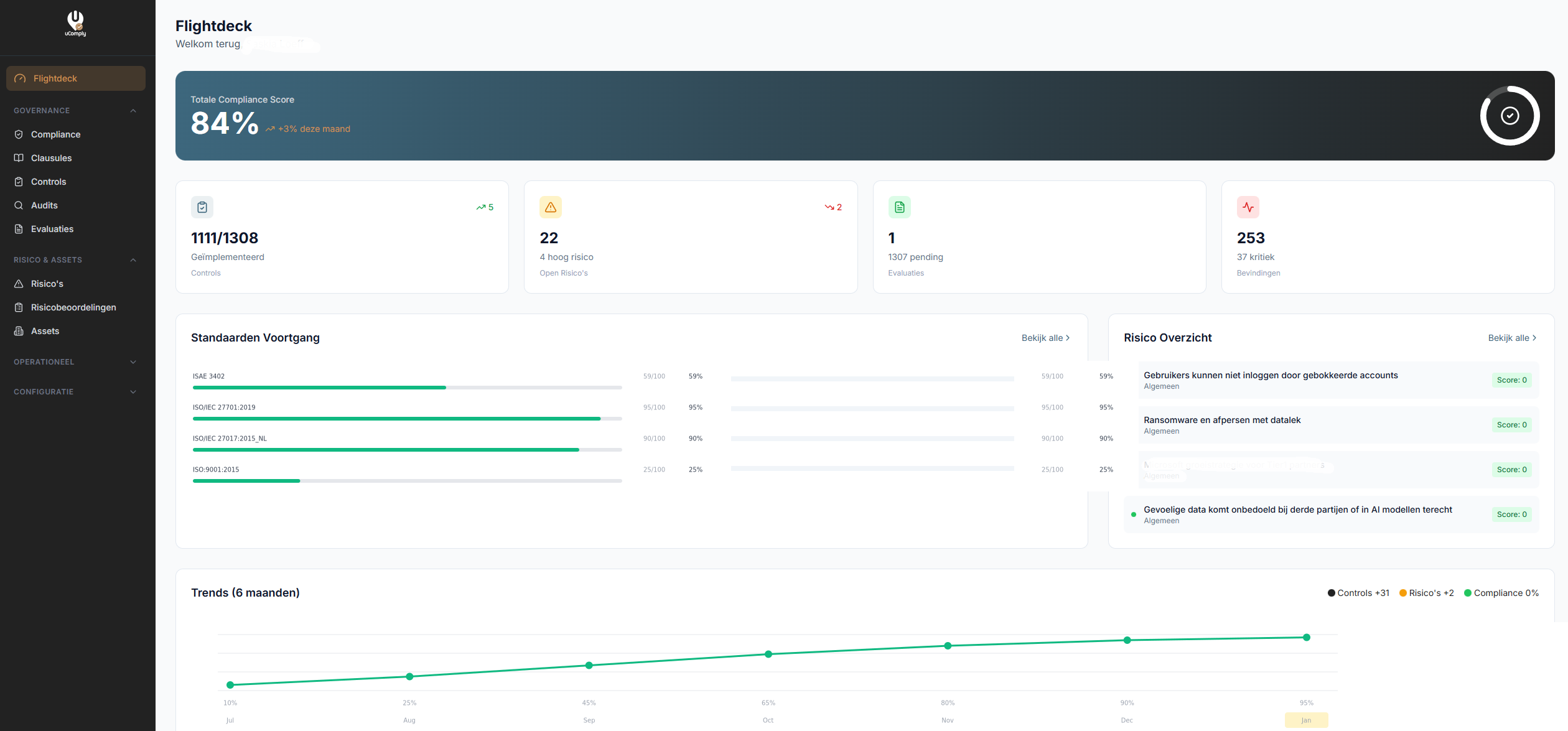
At its core, a GRC tool is a reporting and oversight platform. It collects data from your organization, maps risks, and displays your compliance status on smart dashboards. Think of:
These tools excel at what they do: creating oversight. For organizations with a dedicated compliance team and complex governance structures, that's exactly what they need.
The challenges of a traditional GRC approach
At the same time, the traditional GRC approach comes with certain challenges — especially for SMEs:
A separate platform
A GRC tool is an additional application alongside your existing IT environment. You log into a separate platform, enter data, and generate reports. For organizations with a dedicated compliance team, this works well. But for smaller teams, an extra system can be a barrier.
From insight to action
GRC tools excel at visualizing your compliance status. A dashboard showing that 60% of your controls are green is valuable. But the actions needed to improve the other 40%? They often take place outside the tool — in emails, meetings, and spreadsheets. The dashboard shows what needs to happen, but doesn't always help with the how.
Adoption across the organization
A frequently mentioned challenge is adoption. The GRC tool becomes the domain of the compliance officer, while the rest of the organization barely interacts with it. Compliance quickly becomes seen as "something from that department" rather than a shared responsibility.
What does uComply do differently?
uComply approaches compliance from a different philosophy: not a separate platform, but a system that becomes part of your existing work processes.
1. Work in the tools you already know
uComply integrates with Microsoft 365 — the environment your organization already works in every day. Tasks appear in Outlook. Documents live in SharePoint. Notifications come through Teams. No extra platform, no extra login. Compliance comes to you.
2. The entire organization participates
With a traditional GRC tool, the compliance officer is often the only active user. With uComply, everyone contributes. The HR manager gets a task for the personnel policy, the IT administrator for the backup procedure, the facilities manager for physical security. Everyone works from their own responsibility.
3. From signaling to execution
Where a GRC tool stops at signaling, uComply continues through to execution. The AI assistant helps draft policies — not just register that a policy is needed. Tasks are not only created but also assigned, tracked, and completed.
4. Ready-to-use content
GRC tools typically deliver an empty framework that you have to fill in yourself. uComply delivers content packs with templates, sample policies, and control descriptions. You don't start from zero, but at 80% — and customize it for your organization.
Comparison in practice
A concrete example: you need to comply with ISO 27001 and want to create an access control policy.
With a traditional GRC tool:
Result: You have oversight in the dashboard. The policy has been written, but the tool didn't help with the content. In six months, it's up to the owner to remember that the policy needs to be reviewed.
With uComply:
Result: The policy was written with AI support, stored where it belongs, and is proactively maintained — within the tools you already use daily.
Which approach fits your organization?
A traditional GRC tool is a good fit if you:
uComply is a good fit if you:
The comparison at a glance
| Traditional GRC tool | uComply | |
|---|---|---|
| **Philosophy** | Insight and oversight | Integration and execution |
| **User** | Compliance officer | Entire organization |
| **Works in** | Own platform | Microsoft 365 (Outlook, Teams, SharePoint) |
| **Content** | Empty framework | Ready-to-use content packs |
| **AI** | Reporting and analysis | Drafting and advising |
| **Action** | Signals what needs to happen | Makes sure it actually happens |
| **Suited for** | Enterprise (500+) | SMEs and Enterprise |
Conclusion: different needs, different solutions
There is no one-size-fits-all solution for compliance. Traditional GRC tools are powerful platforms for organizations that need extensive oversight and reporting at a strategic level.
But more and more organizations are looking for an approach where compliance is not a separate project, but part of daily operations. Where not just the compliance officer, but the entire organization contributes. Where you don't start with an empty framework, but with content that gets you on your way.
If that resonates, it's worth discovering what uComply can do for your organization.